Resources
Needing help is not failure, it's teamwork
Repeat after me...

Quinn Daley they/them or she/her
Technical leadership consultant

When I’m coaching people, one issue comes up again and again, either among my clients themselves or the people they manage: getting stuck and not asking for help.
Does this story sound familiar?
You’ve set off to solve a problem or understand some complex system.
You say to yourself “I know I can do this!”
You get stuck.
You feel that you’ve failed, or that you’re not fulfilling your job role, or that you’re letting someone down, or that you are embarrassed to admit you are having a hard time with this piece of work.
Has it happened to you? Then you’re not alone.
Cultural baggage
Many of us have inherited a kind of cultural baggage associated with work and particularly with solo working.
Being strong, and independent, and not needing other people can carry a kind of prestige: proving to yourself that you are good at what you do. This idea might be instilled into us very young by our parents, our schools, our peers.
This is especially true if you identify with a demographic that has historically been marginalised in your field, such as working class people, women, disabled people and the global majority. You often have to work harder than your peers in order to stand out, to be noticed, and you’re more likely to be judged more harshly for your failures too. (This isn’t fair, but it is true.)
And somewhere along the way, we confuse needing help with failure. That if you are too vocal about being stuck, or confused, or just too busy, that it could be read as being bad at your job or having failed at the task you were assigned.
Swap places in your mind
Now, think about this from the other person’s perspective. If you have someone on your team who has been assigned a task, or needs to understand something, and you know how to help them, what would you do if you found out they were stuck or confused?
Would you brain instantly go to “this person can’t do their job”?
Or would it go to “let me see how I can help”?
If you said the latter, it’s because what we’re talking about here is teamwork. Most of us understand all too well what teamwork is when it’s someone else who needs help. But somehow the story feels different when it’s ourselves who need help.
Think of the most successful people you know. People you see as role models because their achievement matches where you want to be. If you can, try watching them at work. Watch how often they ask someone for help. Watch how often they say “I don’t know”. Watch how often they ask for clarification. You might be surprised by the answer!
Your manager’s perspective
As well as thinking about it from the perspective of people who can help, try thinking of it from the perspective of someone whose job it is to manage your workload and report on your progress.
If you are stuck and you immediately ask for help, your manager is able to see their team working effectively and supporting each other to solve problems. If it puts a task behind schedule, they have all the information they need to report on the status or reassign people or projects to make sure it gets done.
If you are stuck and you are determined to get yourself out of the hole without telling anyone that you are stuck, from your manager’s perspective they’ve lost sight of you - they can no longer see your progress. If and when you do complete the piece of work, they might have no idea you needed help - instead they’ll have to draw their own conclusions about why it took you longer than expected.
If you see the problem from the manager’s perspective, it’s hopefully easier to see why being vocal about being stuck or needing help makes you look better at your job, not worse.
Maybe you could do it by yourself
Often, when we’re stuck, we know that we can get to the solution or handle the overwhelm eventually.
Maybe you don’t need help, in the strictest sense of the word, because given enough time and space, you can do the thing completely alone.
And maybe this might even be your preference: proving to yourself that you can do it independently.
But, perhaps, you also recognise that in this situation you are a bit stuck or overwhelmed, and you would solve the problem more quickly and with less stress if you had a little help. You don’t need help, but you would benefit from it.
Rewiring your brain
The key to breaking this habit is to recognise that when you join a team, you are all working together to solve shared problems.
When someone assigns you a piece of work, that doesn’t mean you have to complete that piece of work by yourself. It doesn’t mean anyone is expecting you to complete the work by yourself. It means someone is expecting you to take point on that piece of work - to be the person who works out how the work is completed and reports on any challenges or needs along the way.
If you rewire your brain to think of assignments this way, eventually you’ll start to think of being stuck and needing help as just part of being on a team.
So I’ve come up with a little mantra you can repeat to yourself to aid with this gradual rewiring of your brain:
When I need help, it is not failure. It is teamwork.
Next time you find yourself stuck on an assignment, or feeling like you can’t achieve something by yourself, try repeating this phrase to yourself.
(It works even if you’re completely self-employed, by the way. Let me know if you want tips on how to do this when you’re not officially part of any team.)
Another free poster!
After the first free poster, I hope you still have space on your wall. Print this out and put it somewhere you can see, so it can remind you whenever you’re frustrated or overwhelmed.
There’s a little QR code that will take you straight to this blog post if you need the detail again.
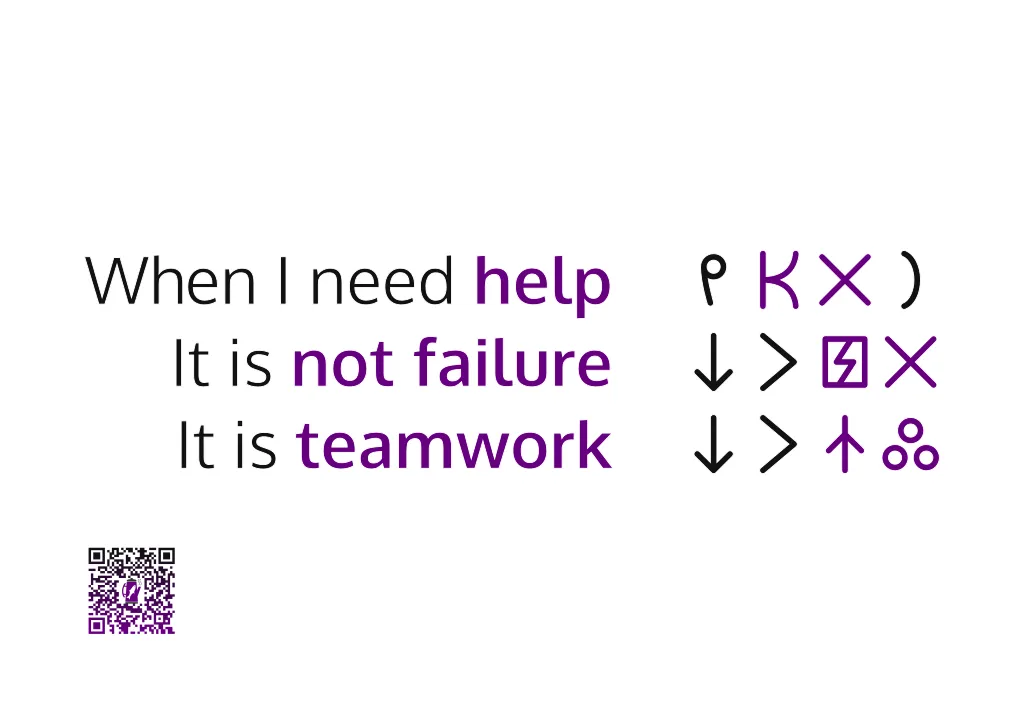
(Thanks to ale sa and ilo Niwe for help with the translation into toki pona. I was stuck with this translation and I needed help: teamwork!)
Download poster as a printable PDFIf you print this out and put it on your wall, get in touch and show me a picture of it! I only know these blog posts are useful when people engage with them and let me know, so thank you to all of you who do!
Happy teamworking!
Fish Percolator is a technical leadership consultancy based in Yorkshire.
If your team is not running as smoothly as you'd like, you have long gaps between releases or bugs in production, or your people are not excited about coming to work every day... we can help!